 Martin meets with TBS Dinner & a Movie host Paul Gilmartin who talks about his love for the Danish Modern design. They discuss Paul’s passion – his craft of hand shaped pieces in the Danish style. Click here to see Paul’s work.
Antiques, Art, Vintage and Collectibles Blog and Research Information Forum
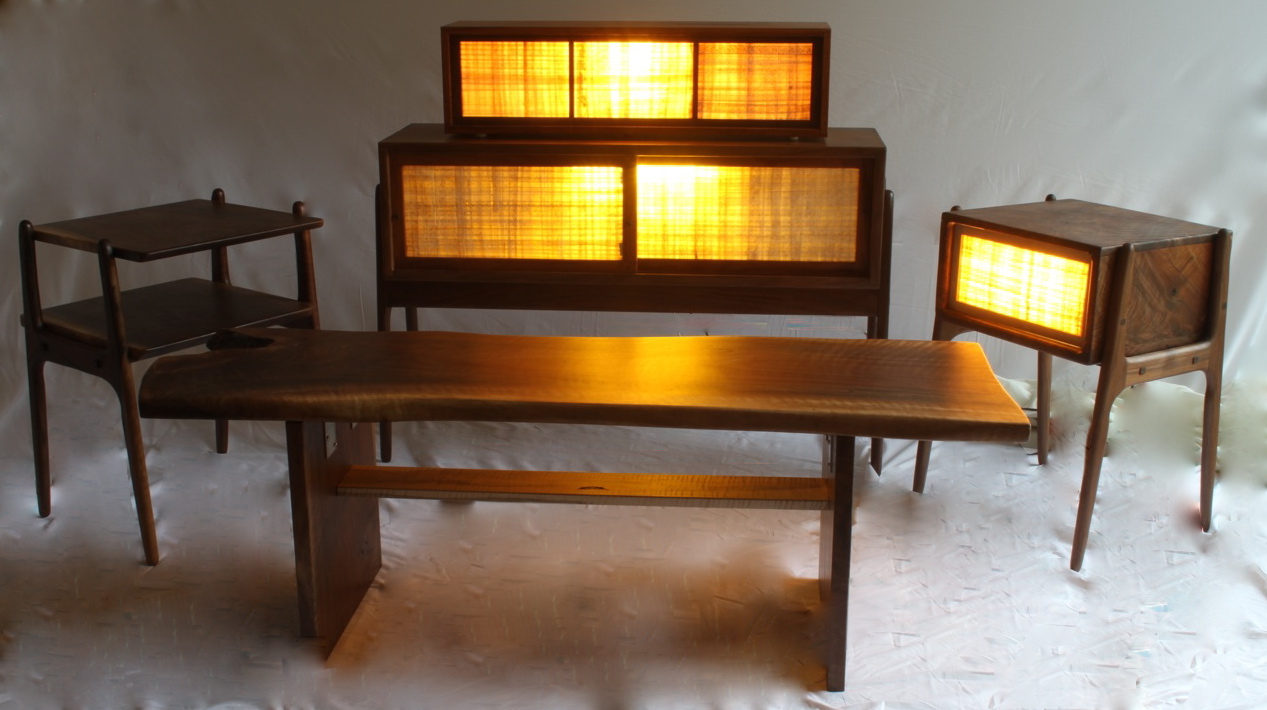
Martin meets with TBS Dinner & a Movie host Paul Gilmartin who talks about his love for the Danish Modern design. They discuss Paul’s passion – his craft of hand shaped pieces in the Danish style. Click here to see Paul’s work.

By Martin Willis
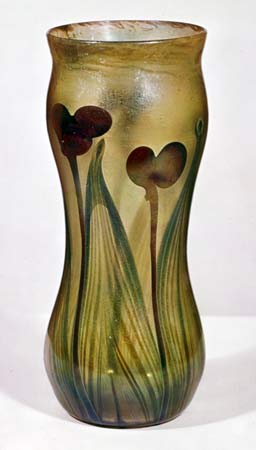
I enjoy the work of Louis Comfort Tiffany and after Reyne Haines and I did Podcast #72. about his glass, I decided to write a little about him. There is so much to write when it comes to Tiffany, I am only able only touch on a few facets with this blog in the area of windows and art glass.
When you look back in time, you can see that there have been only a hand full of individuals who have truly shaped our world. Louis Comfort Tiffany did just that with American design & decorative arts the last part of the 19th through the early 20th century. His influence still affects pieces made to this very day.

Louis was born with a very nice silver spoon on February 18, 1848 to Charles Lewis and Harriet Olivia Young Tiffany. Charles started out with John B. Young in stationary goods and gifts in New York City. He eventually became the founder of Tiffany & Co. (Tiffany & Young Co.). He imported goods and fine treasures from all over the world. He eventually employed some of the finest silver makers & jewelers in the country. Growing up in an environment like this heavily influenced Louis and soon he decided that he wanted to become an artist.
 In my opinion the works that I have seen by Louis have been very strong. He painted oils and watercolors and often in the orientalist manner. He studied art under George Inness and Samuel Coleman in New York and under Leon Bailly in Paris.
While he was an extremely talented artist, he knew in his heart that he could only seek a certain level as a painter and this was not good enough for him.

Around 1875 he turned to working in another medium, glass. He actually spent time working in several glass houses in Brooklyn between 1875-1878.
Tiffany’s father’s money and influence gave him a perfect launching pad for his creativity. In 1879, he joined with Candace Wheeler, Samuel Colman and Lockwood de Forest to form Louis Comfort Tiffany and Associated American Artists. With over 100 artists and associates, he began decorating homes of the influential including the Mark Twain House in Hartford, CT and later to the Whitehouse under Chester A. Arthur. This company lasted until 1885 and the breakup was mostly because Tiffany wanted to get back to glassmaking. Tiffany Glass Company was formed later that year in December, (the name changed to Tiffany Studios in 1902).
 He began designing and making windows, yet both he and John La Farge were frustrated working with the stained glass that they could purchase, and ultimately began creating their own glass. If you have ever looked at one of Tiffany’s windows with the sunlight coming through or a lamp well lit, you know the sheer beauty of the glass he created. There have been many copycats, but no one has ever come close to recreating the richness of color that his glass possessed. Tiffany eventually had the largest stained glass studio in the country. He employed hundreds of people and made thousands of windows. I hope the reader is able to enjoy the beauty of his work. There are great examples even in California, such as St Peter’s Chapel, Mare Island.
As electricity started to flow throughout the homes of our country, Tiffany took full advantage with the mosaic shades he created. I knew the granddaughter of one of Tiffany’s lamp makers and she had a wonderful collection. It sadly owned her, as she did not dare to leave her house. More about lamps and other creations at another time.

Louis was heavily influenced by the iridescence of Roman glass (caused by decay) that he had seen at the Victoria and Albert Museum in 1865. This extensive collection of Roman and Syrian glass made a deep impression on him. He began working with chemicals to produce a similar effect. Favrile Glass is a type of iridescent art glass designed by Tiffany. It was patented in 1894 and first produced in 1896. It differs from most iridescent glass because the color is ingrained in the glass itself, as well as having distinctive coloring.
Tiffany’s art glass remained in demand until he died in 1933, it fell out of favor for many years and started a comeback in the 1960s. It is still going strong today.
I always like to talk about fakes on my podcasts, so I will touch on that a little here. A genuine Tiffany piece should shout out quality when you first look at it. If you look at a piece that is supposed to be Tiffany, yet in your gut, something is missing or it looks too “something”, then you are most likely right. As Reyne Haines says, the signature is the last thing you should look at. However, this may take a trained eye. If you are a novice collector, I would suggest to turn to a reputable dealer or auction house that will stand by their descriptions.
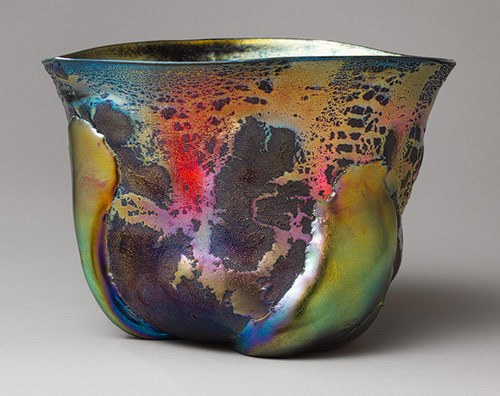 Another topic Reyne and I talk about in the accompanying podcast is, that it is important to buy what you like. Don’t buy something that you think is rare, but do not like. You are the one who has to live with it. Also, you are much better off using the same amount of money that it would take to buy ten mediocre pieces and buy one very nice piece instead. It never hurts to collect variations as well.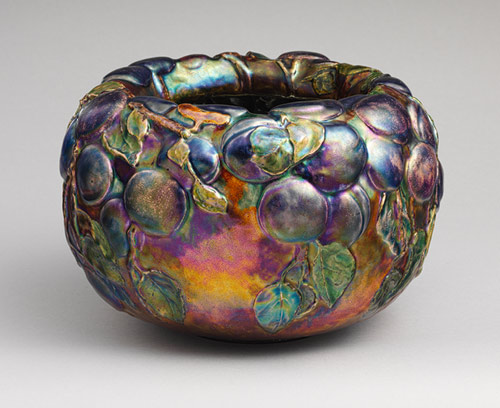
As I said in the beginning, there is much to write and talk about on Louis Comfort Tiffany. It is hard to even scratch the surface of one or two areas of his work in a blog. I hope some of you enjoy viewing the fine works of the Louis Comfort Tiffany as much as I do.
Happy hunting everyone!
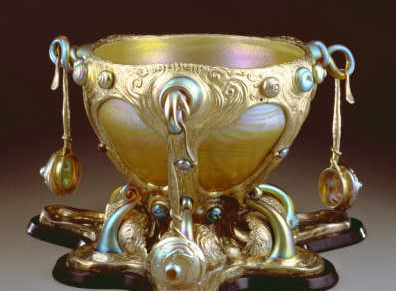
 Reyne & Martin record an informational podcast together on one of Reyne’s specialties, Louis Comfort Tiffany’s art glass. They talk about the beginnings to when it had fallen out of favor in the 1930s to the 1960s. They discuss Lillian Nassau’s role in bringing the collectibility back and what the market is like today. They also touch on art glass such as Loetz, Durand, Quezal, Steuben, Ludberg and more.
Check out Martin’s blog on Tiffany Glass: Click Here
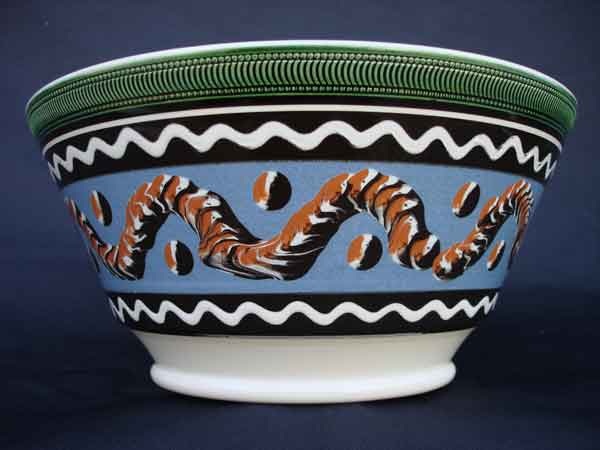
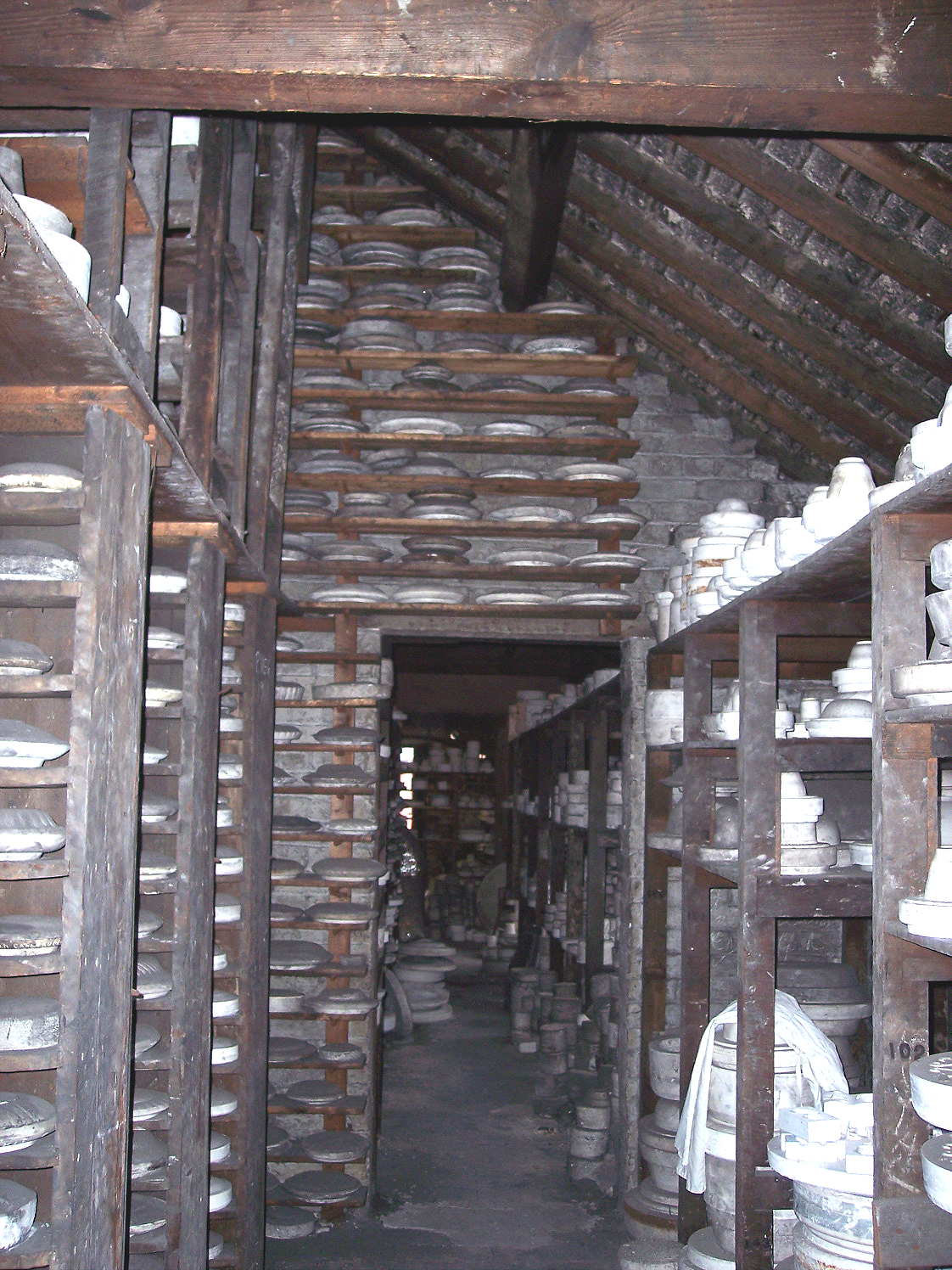 Martin talks with guest Don Carpentier from Eastfield Village, New York about his skilled craftsmanship of recreating mocha wares (click here for info.), and the historical rescue of the early ceramics molds (60,000 of them) from the closed Spode Factory in England. Click here for here for images & history of Spode .
Click here to visit Don’s website.
By Martin Willis
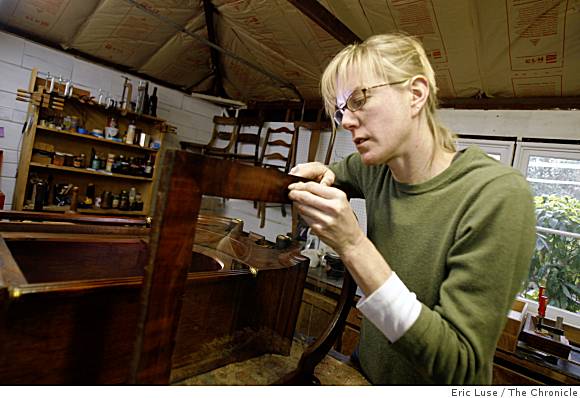
There has always been controversy on when someone should refinish on old piece of furniture and when they should leave it be.
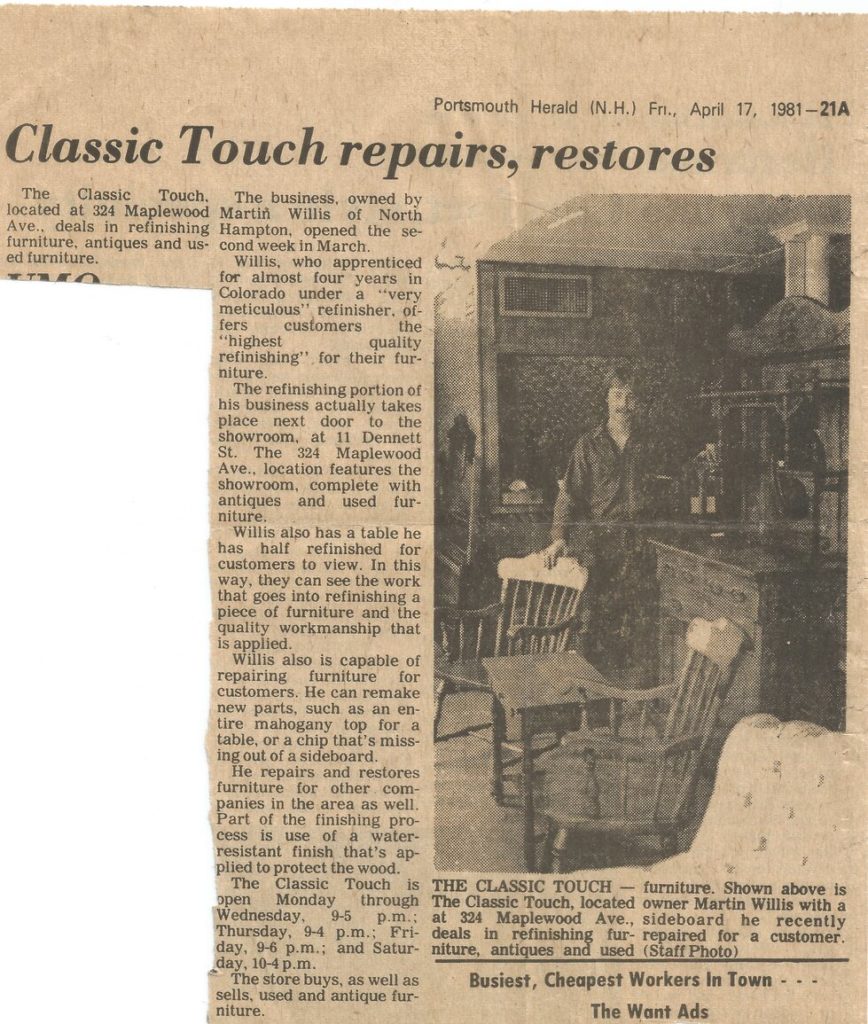 I did antique restoration and the refinishing of mostly oak back in the “golden oak“ days. My opinion always was, if it is not a period piece, and it is machine made, then it does not matter if it is refinished or not. That was many years ago and I have not touched sandpaper to wood for a long time. In hindsight my thoughts about refinishing were rather narrow-minded. Just because something is machine made does not mean it cannot be or cannot become important. A hundred years from now, someone may be cursing me for all the refinishing I have done, so I will apologize now in advance.
Luckily, no one ever asked me to refinish a nice arts & crafts piece, however it does seem like the majority of these pieces are not in original finish.
I had a restoration shop when I was in my early 20s for about ten years. I bought a plain oak lamp table at my father’s auction for $10 for display purposes. It had a horrible water stained top and the finish was flaking off. I sawed it in half, refinished one side of it and braced it back together. I put this piece in my showroom so I could display the before an after of my work which was night and day. Not long after the table appeared a crusty old New Englander came in my showroom and started yelling at me for sawing the beautiful table in half. I simply pointed at the original condition side and asked him what he would pay for the table if it looked like that.
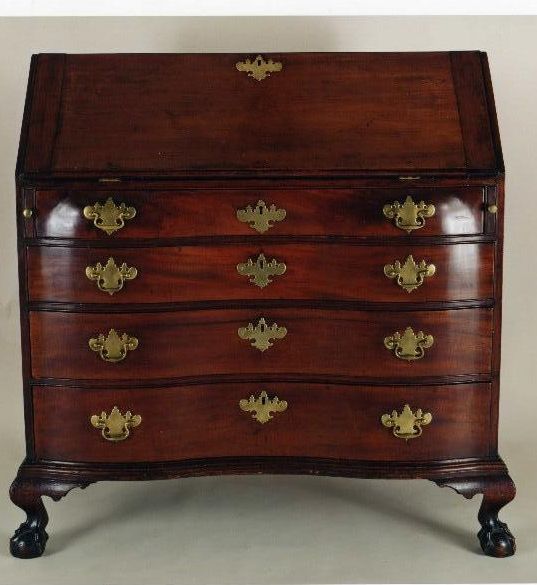 Original surface is a big deal on period furniture and I would strongly suggest to my clients that they not refinish period pieces. My best friend’s wife asked me to refinish a period Boston Chippendale desk they inherited in original finish. She was complaining that the finish was dry and crusty (just like the purists like it). I refused to touch it and told her there were other options, unfortunately she went to the phone book and someone else did the deed to my dismay. It was a horrible polyurethane job, shiny as can be and rough to the touch. There were orbital sander marks covering the whole piece.
If you just cannot live with a finish the way it is on a period piece, then you can have it French polished. French polishing is done with a finish amalgamator that is basically blending the finish into itself and then finally rubbed down with pumice. It creates a beautiful luster finish out of the original that is soft to the touch. It takes a lot of time and patience to do the job correctly. A person who is skilled at this procedure can be in high demand. For instance, I was in a 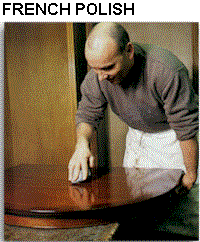 home of a collector with beautiful period pieces, all of which were wonderfully French polished. I had a piece in mind that I wanted to have done and I asked her who did her polishing. She thought for a minute and said that she was sorry, she could not tell me. When I asked her why, she said that she did not want him to have too much work otherwise, she would have to wait too long to get her work done. As you can guess, she is a hardcore collector. While I am on this subject, I have an upcoming podcast with a very skilled restorer so named Tony Cardona. We will touch on that subject among other facets of restoration.
I still say there is a time when to refinish something and here are my humble opinions. 1. If a piece is painted that was originally finished. 2. If the finish is flaking off down to bare wood. 3. If there is water damage and the finish is totally destroyed.
Contemporary durable finishes seem tempting, but you should only use the type of finish that was originally used on the piece when it was made. That can easily be researched online these days. You can use orange shellac for 18th century pieces, just remember, it does not hold up to water.
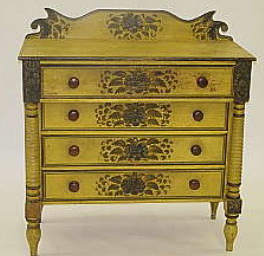 Now let’s touch on painted surfaces of period pieces. Nothing is more desirable to a collector then an untouched original painted surface. I saw a situation at auction with a pair of fine chest on chests, one in original mustard color paint and the other stripped and refinished. The mustard color one sold in the six figures because of the remarkable surface. The twin that had been refinished sold for under $20,000. I ask of anyone reading this, if it is period pieces in original painted surface do not touch it with anything. If you think it is dark, or you would rather see it refinished and shiny, do the collecting world a favor and sell it to someone that appreciates it just the way it is.
If you are going to have a piece worked on, I would suggest taking it to someone that has a great reputation among antique dealers. You do not want a period Boston desk refinished in polyurethane.
As a former refinisher, I can tell you that there is nothing like a nice original finish on a great piece. Now I am finished talking about finishes, thank you for reading!
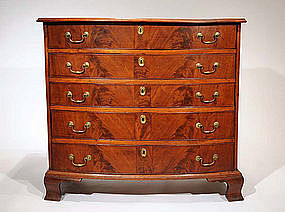
by Martin Willis
This editorial is about American furniture, I may write at a later time explaining how to tell the difference between Period American and English Georgian furniture of the same era. When I speak of period furniture, I am referring to pieces that are considered traditional styles of design constructed in the Colonial through Federal era, between 1730-1810 such as Queen Anne, Chippendale, Sheraton, Hepplewhite, Duncan Phyfe and Federal furniture. Following this era was American Empire 1815-1835 , then Victorian 1837-1901 of which machine made furniture began in 1840.
Centennial furniture was born in the traditions mentioned above debuting at the 1876 International Centennial Exposition in Philadelphia. There was a nostalgia for the developing years of our country and the pieces became in high demand. This was in the midst of the Victorian Renaissance Revival styles mostly of walnut adorning the homes and parlors of the nation.
After the Centennial era, Colonial through Federal styles have had many revivals up to the present day.
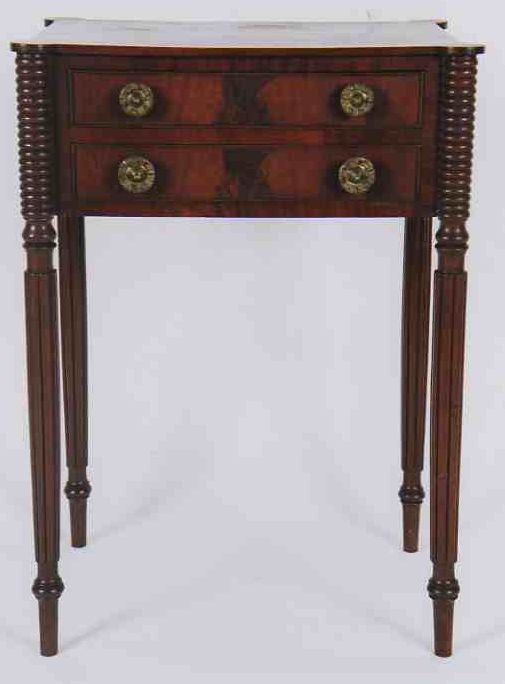
Let’s start out by talking about a side-by-side comparison of a Sheraton two drawer work table.
They made a vast amount of Federal Era Hepplewhite and Sheraton style side tables. Yet they made even more Centennial era and later pieces in the same styles. Side by side in a home, even after many years, I can sometimes not tell the difference until I closely examine the piece. Like most furniture, it is the underside that tells the truth. What you are looking for is handcrafting and age compared to machine made with less age.

Before you tip the table upside down, pull out one of the drawers and turn it over. On a period piece, you should see what is called a chamfered edge. It is a thick board planed to a wedge that fits in the bottom slots of the drawer. Now you want to look at the dovetail edge of the drawer. The best thing I can do is show you images of both machine dovetailing (which is uniform) and hand dovetailing. Note: click any image to enlarge.
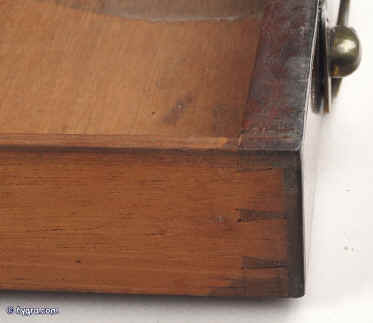
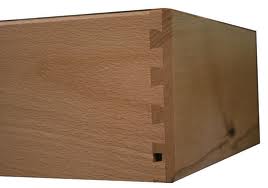
On hand dovetailing, often you see the marking scores that were used to lay the dovetailing out. Not only is construction a good way to tell a period piece, but also there should be age oxidation. Over time wood develops a dark natural look, mostly where it is exposed to air. I have seen an early high chest that had poplar secondary wood with very little oxidation where the drawers had dust divider panels, so there are exceptions. It made me suspicious and keep in mind being suspicious is a good thing when examining pieces. I always think guilty until proven innocent.
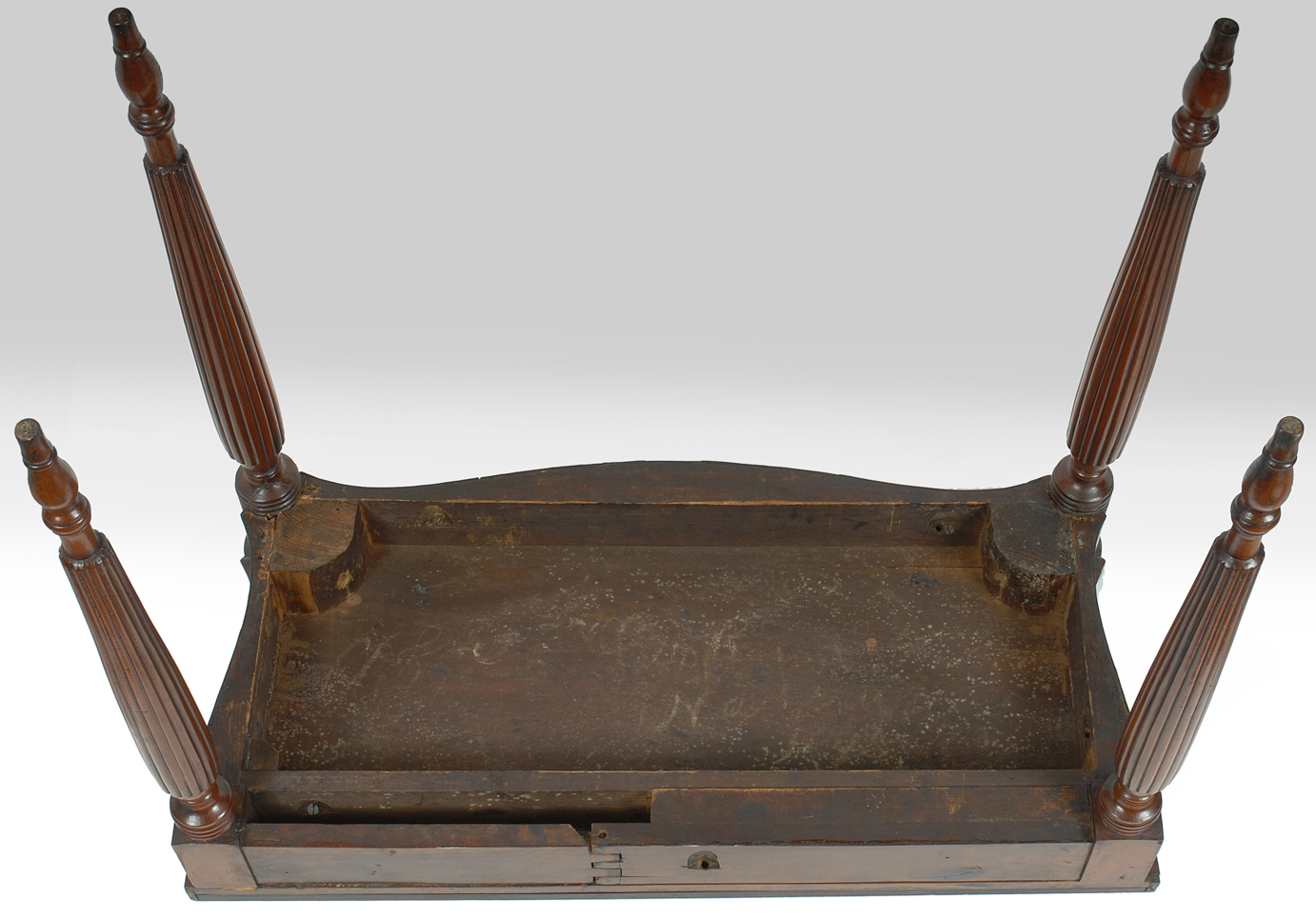
Now take the table, and turn it upside down, preferably on a carpet or blanket. You should see areas of oxidation. The inside the top should be attached by screws. Take a flashlight and look to see if the screw countersink holes appear to be made by hand with a chisel or machine drilled. Now look at the screw heads inside the holes, in particular the slots. If the slots are not perfect in the center, you have a good shot it may be a period piece.
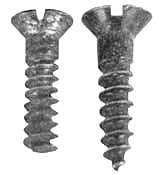
A Centennial piece (and later) will have machine drilled countersunk holes and screw that are slotted perfect on center.
If you have an early table with turned legs, grasp one and turn your hand slowly back and forth. You should be able to feel a slight oval shape. Wood shrinks over time across the grain. Centennial and later pieces have much rounder turnings than period pieces.
I always look at the bottoms of feet on pieces to look at age as well. It is hard to explain what I am looking for other then wear and age.
You will never see band saw work on a period piece and you will rarely see perfect uniformity of construction on the underside of a period piece.
I will offer another tip a little off track to this subject. If you are convinced you are looking at a period chest on chest, or any two-part piece, you want to make sure the two parts belong together and were not “married”. Two ways to tell are, make sure the backboards are matching (color and tooling) and then stand to the side of the piece.
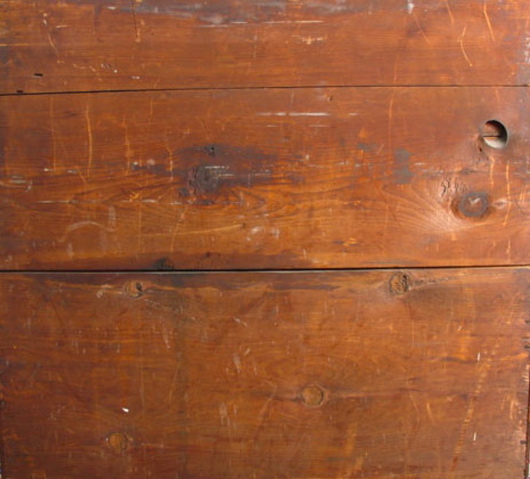
Pull a drawer from the top section and one from the lower section. Make a close examination to make sure the dovetail work matches on the two drawers. If either the backs or drawers look suspiciously non-matching, you probably have a married piece.
If you are not a seasoned expert, there is no sure fired way while examining pieces for you to be certain, these are just helpful tips I have learned along the way.
We have been getting a lot of email these days and have enjoyed helping people identify antique objects & art. Feel free to send us images of your pieces.
Happy hunting!